Safepay
Ransomware Active- Origin
- Unknown
- Motivation
- Financial
- First seen
- Nov 20, 2024
- Last activity
- 2 days ago
- Techniques
- 150
- Victims posted
- 627
About
SafePay ransomware started in October 2024 as a new ransomware service, using some of the leaked LockBit source code. Soon after launching, the group made a big impact in the ransomware world, hacking at least 33 organizations by December 9. The first version of SafePay was created by modifying the LockBit source code. It adds the ".safepay" extension to files that it encrypts and includes a ransom note called "readme_safepay.txt." This version uses a three-step XOR method with a random single-byte key, making it hard for security researchers to analyse. The group's technical infrastructure includes both a dark web blog and a presence on the TON network for victim communications. Their attack methodology follows a double extortion model, combining traditional file encryption with data theft to maximise pressure on victims. SafePay operators typically move from initial access to ransomware deployment in under 24 hours, significantly faster than the industry average.. Among the Tactics, Techniques, and Procedures (TTPs) of the SafePay group, notable characteristics include the use of compromised VPN credentials as an initial access vector, extensive use of living-off-the-land binaries (LOLBins), and sophisticated privilege escalation techniques. The group frequently employs ShareFinder.ps1 for network reconnaissance and uses WinRAR for data archival before exfiltration. Post encryption, SafePay directs victims to their negotiation portal accessible through both Tor and TON networks. The group has demonstrated sophisticated operational security measures, including a Cyrillic-language-based killswitch that prevents execution in eastern European countries.
Victims per month (12 months)
Leak site as captured
17 Nov 2026 15:09 UTC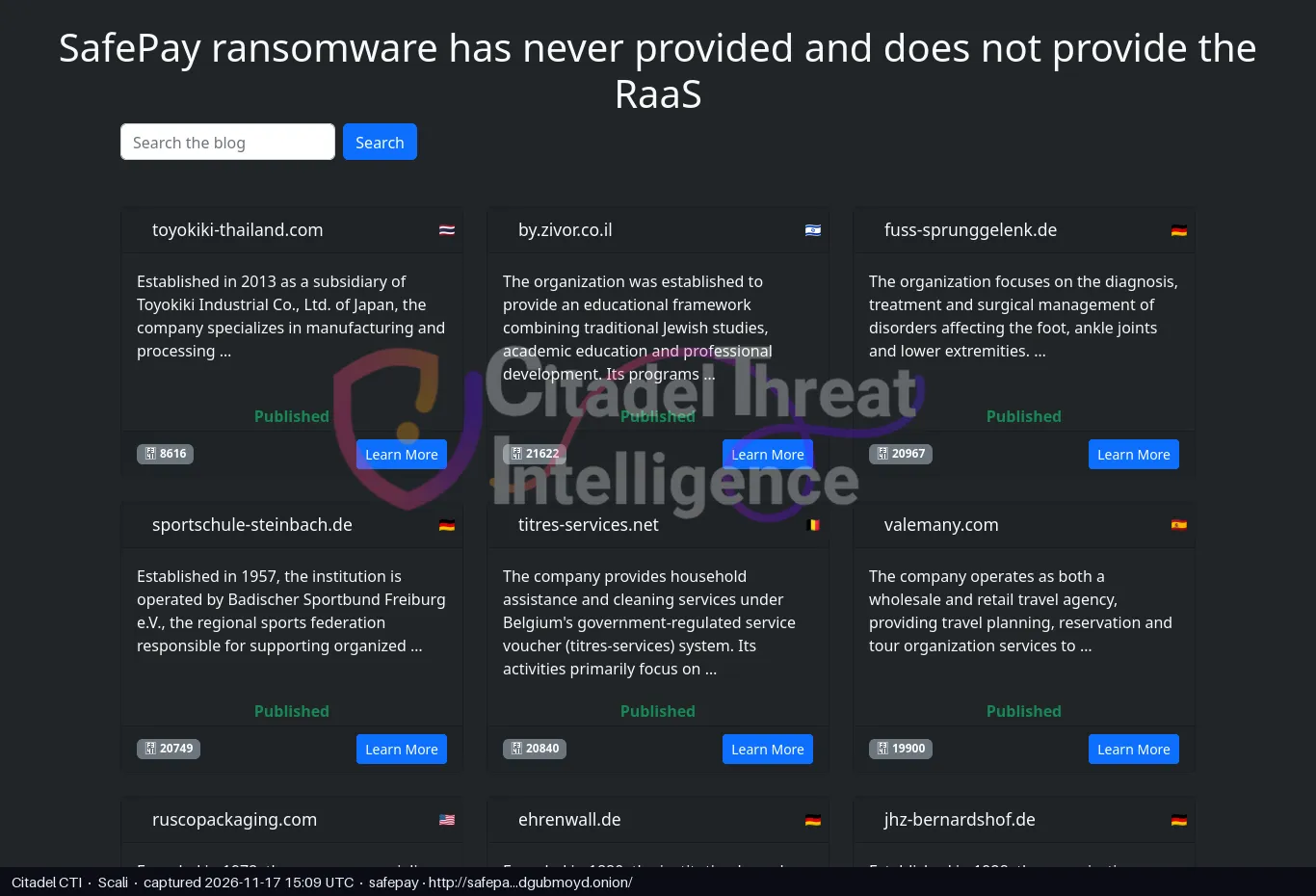
Leak sites & mirrors
1 online 15 offlineAddresses collected and maintained by Amit Cohen Scali, CTI Research Lead at Citadel
Tools & malware
Malware · tools (often legitimate software abused)
Contacts & addresses
How the group asks to be reached and where it publishes, as open sources list them. Full addresses: approved researchers only.
- Email · 1
-
Va…4@protonmail.com RansomLook
- Sites · 1
-
cqkrkm…seij5gad.onion Leak site · Ransomware.live
Attribution reflects public research and can change. Technique data: MITRE ATT&CK® (see notices).